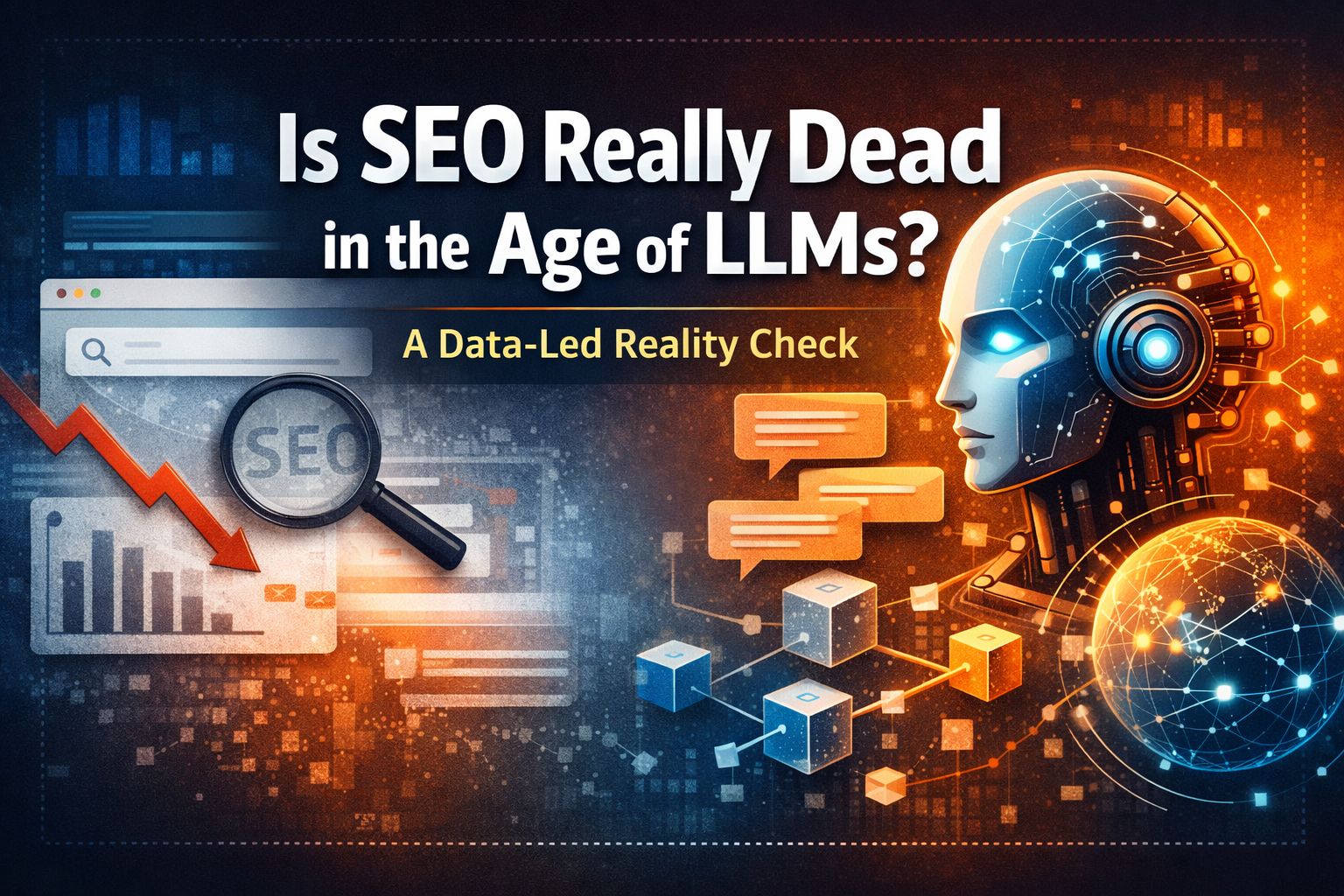
Over the last year, one question has dominated conversations across marketing, product, and leadership teams:
“Is SEO dead because of LLMs?”
With tools like ChatGPT, Gemini, Perplexity, and AI Overviews changing how people discover information, it’s a fair concern. Traditional search behaviour is evolving, clicks are under pressure in some verticals, and AI-generated answers now sit between users and websites.
But declaring SEO “dead” oversimplifies what’s actually happening.
The reality is more nuanced — and far more interesting.
Why People Think SEO Is Dying
The argument usually rests on three visible shifts:
- AI answers reduce clicks
Users increasingly get summaries without visiting a website. - Search interfaces are changing
Blue links are no longer the only discovery layer. - Content volume has exploded
AI has made it easier to publish, raising concerns about saturation and declining value.
Taken together, it feels like traditional SEO rules no longer apply. In some cases, they don’t — at least not in the same way.
But this isn’t the end of SEO. It’s a transition.
What the Data Actually Suggests
While zero-click behaviour is increasing for informational queries, high-intent searches still convert. Commercial queries, solution comparisons, service discovery, and brand research continue to drive meaningful traffic.
More importantly, LLMs don’t replace the web — they depend on it.
Large language models:
- Learn from existing web content
- Reference authoritative sources
- Surface brands with consistent signals across search, content, and mentions
When an AI system recommends a company, product, or process, it is not inventing authority. It is recognising it.
That recognition is built through the same foundations SEO has always relied on:
- Clear topical relevance
- Demonstrated expertise
- Consistent publishing
- Technical accessibility
- Brand trust signals
What’s Actually Changing in SEO
SEO is not disappearing — it’s shifting focus.
From rankings to relevance
Ranking first matters less if your content isn’t referenced, trusted, or cited by AI systems.
From keywords to entities
Search engines and LLMs increasingly understand topics, brands, and relationships — not just exact phrases.
From traffic to visibility
Being visible inside AI answers, summaries, and recommendations is becoming as important as traditional clicks.
From volume to depth
Thin, repetitive content struggles. Structured, experience-led content performs better across both search engines and LLMs.
Why LLMs Still Need SEO
LLMs do not crawl the web independently in real time. They rely on:
- Search engines
- Indexable content
- Structured data
- Clear site architecture
- Trusted domains
Without SEO:
- Content becomes harder to interpret
- Authority signals weaken
- Brands lose discoverability across AI surfaces
In practice, SEO now underpins AI visibility.
If your site is unclear, poorly structured, or lacks topical authority, LLMs are less likely to reference it — even if your content exists.
What “Good SEO” Looks Like in an LLM World
SEO in the age of LLMs prioritises clarity and credibility over tactics.
Key focus areas include:
- Topical authority, not isolated keywords
- Entity optimisation (brand, people, services clearly defined)
- Structured content that is easy to summarise and reference
- Technical foundations that support crawling and understanding
- Experience-led insights that AI systems can’t easily replicate
This is not about gaming algorithms. It’s about making your expertise easy to understand, trust, and surface — whether the audience is human or machine.
The Real Risk: Doing Nothing
The biggest mistake businesses can make right now is assuming SEO no longer matters and stepping back entirely.
When that happens:
- Competitors become the sources AI systems reference
- Brand visibility declines quietly
- Recovery becomes harder and more expensive later
SEO is no longer just about winning clicks. It’s about owning your place in the knowledge layer of the web.
Final Verdict: SEO Isn’t Dead — It’s Evolving Fast
SEO has always adapted to change:
- From desktop to mobile
- From keywords to intent
- From links to experience
- From search engines to AI systems
LLMs haven’t killed SEO. They’ve raised the standard.
Businesses that invest in clear positioning, high-quality content, and strong technical foundations will continue to benefit — across Google, AI search tools, and whatever comes next.
The opportunity hasn’t disappeared.
It’s simply moved upstream.